
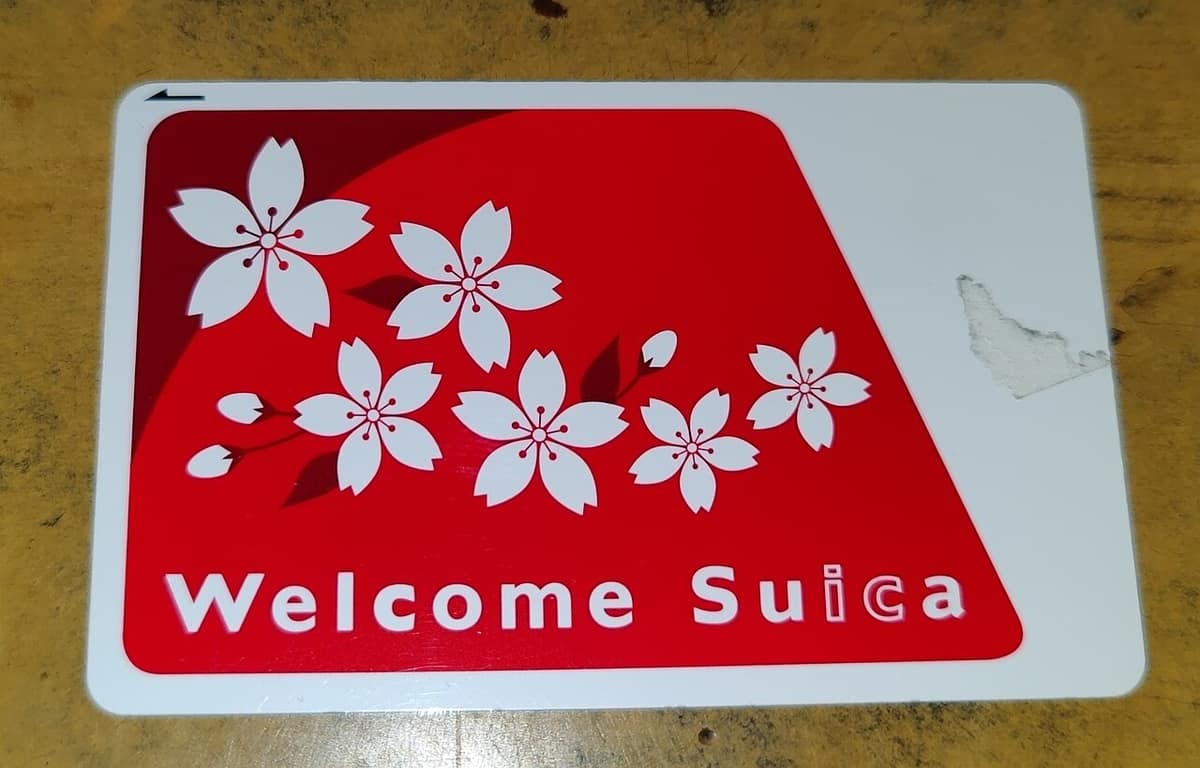
An IC card is a rechargeable smart card for trains, buses and many shops in Japan. For tourists, Narita and Haneda airport offer two cards: JR East’s Welcome Suica and, since 2026, the Tourist PASMO. Both are valid for 28 days, have no deposit and are topped up with cash. The remaining balance is not refunded. All details come from the operators, as of 25 October 2026, and sales points and prices can change.
Key takeaways
- Online from arrival: you set up an eSIM at home, from €3.49 with Saily* (advertising) (1 GB, 7 days).
- Welcome Suica: valid for 28 days, 1,000 to 10,000 yen of credit, no deposit, no refund. Sold at the airport stations Narita Terminal 1 and Terminal 2·3 and Haneda Terminal 3 (Monorail).
- Tourist PASMO: new since May 2026, also 28 days with no deposit. At Haneda at the Keikyu stations, at Narita from Keisei (only with 2,000 yen).
- Top-up: at machines with cash, not by credit card. Maximum 20,000 yen.
- Narita Express and Skyliner: the card only pays the base fare. For these trains you also need the matching ticket.
- Mobile Suica: the tourist app exists only for the iPhone. For Android devices bought abroad, use is not reliably possible.
Which IC card can I get at the airport?
Welcome Suica is sold, according to JR East, at Narita Airport Terminal 1, Narita Airport Terminal 2·3 and Haneda Airport Terminal 3 (Tokyo Monorail) stations, at the JR EAST Travel Service Center and at machines. The card costs 1,000, 2,000, 3,000, 4,000, 5,000 or 10,000 yen at purchase, and that amount is your credit. There is no deposit, and in principle one card per person. At Narita, the Travel Service Center is on the basement level (B1F) before security in Terminal 1 and Terminal 2, according to the airport. At Haneda Terminal 1 and 2, JR East does not sell Welcome Suica.
Tourist PASMO is the new tourist card and replaces the earlier PASMO Passport, whose rules were abolished in October 2024. According to PASMO, sales started in May 2026. It is valid for 28 days, has no deposit and a maximum balance of 20,000 yen. At Haneda there are machines for travellers at the Keikyu stations Terminal 1·2 (1,000 to 10,000 yen, payable by credit card) and the Keikyu Tourist Information Center in Terminal 3. At Narita, Keisei sells the Tourist PASMO at the SKYLINER & KEISEI INFORMATION CENTER in Terminal 1 and Terminal 2, only with 2,000 yen.
Regular Suica and PASMO with a 500 yen deposit were not sold to tourists at times between 2023 and 2025 and have been available again since 2025. For the airports we currently have no reliable evidence of exactly where they are sold. For a trip of one to four weeks, Welcome Suica and Tourist PASMO are the better choice, because they need no deposit and no return.
How do I top up the card?
- Welcome Suica: at ticket machines or fare-adjustment machines with the Welcome Suica symbol up to a maximum of 20,000 yen, and at Seven Bank ATMs in 7-Eleven and other shops. Cash in yen only, no credit card.
- Tourist PASMO: at machines with cash up to 20,000 yen, on the bus with 1,000-yen notes (maximum balance 10,001 yen) and at convenience stores and some shops.
What happens to the remaining balance?
With Welcome Suica and Tourist PASMO there is no refund of the balance, and you may keep the card as a souvenir. A lost card is not replaced. So plan the amount tightly and top up more often if in doubt. The back of the Welcome Suica shows a “GOOD THRU” date that is not the expiry date. The real expiry date is on the receipt (Reference Paper) you get at purchase. Keep it. A regular Suica is returned at a JR East station: you get the 500 yen deposit and the remaining balance minus a 220 yen fee, and the deposit is always refunded.
Where does the card work, and where is it not enough?
With the nationwide-use logo, Suica, PASMO, ICOCA and other IC cards work with each other across Japan, including the Welcome Suica. A journey cannot continue across area boundaries, though: at the end of the area you leave the gate and check in again. You can pay in shops, restaurants, at vending machines and lockers with the IC logo.
For trains with a surcharge the card alone is not enough:
- Narita Express (JR East): in addition to the IC card or ticket you need a Super Express ticket, available at the Travel Service Center, the Midori-no-Madoguchi or reservation machines.
- Skyliner (Keisei): the base fare can be paid with PASMO or Suica, but the Skyliner ticket with a seat is mandatory, otherwise a surcharge applies. We do not give exact prices because the Keisei pages contradict each other. Ask at the Skyliner counter.
- Limousine Bus: IC cards are only valid on certain routes. Ask at the counter. On the bus itself you can only pay with 1,000-yen notes and cannot top up.
- Tokyo Monorail: the Welcome Suica can be used.
From 6 to 8 November 2026, parts of the Narita Express run on a limited schedule due to construction work, with trains only to and from Tokyo Station. If you arrive at Narita that weekend, check JR East’s current notices.
Internet from the moment you land: set up an eSIM in advance
For maps, timetable apps and the Suica app you need internet on the go. The most comfortable way is an eSIM that you set up at home, so you do not have to look for a shop or counter after landing. Three providers to compare (prices as shown on the providers’ pages, as of 25 Oct 2026):
- Saily* (advertising): from €3.49 for 1 GB and 7 days, larger plans up to unlimited data.
- Yesim* (advertising): from €3.50.
- Airalo* (advertising): from €4.00.
Compare data allowance, validity and price directly with the providers and check beforehand whether your phone supports eSIM. All ways to get online are compared in our guide Internet in Tokyo from the airport.
Mobile Suica: does it work on a phone?
- iPhone: the “Welcome Suica Mobile” app issues a tourist Suica valid for 180 days. You need an iPhone XR, XS or newer with iOS 17.2 or later and a credit card in Apple Pay. The balance is not refunded. The app requires location services. Germany is not on JR East’s list of countries where issuing before arrival is possible (as of March 2025), so it probably works only once you are in Japan. Whether a German credit card works for top-up is not documented. Keep the physical card as plan B.
- Android: PASMO states that Android devices bought outside Japan are generally not compatible with Mobile PASMO. Google Wallet supports Suica and PASMO only on devices with Japanese radio technology (FeliCa). For these users the plastic card remains the option.
Common mistakes
- Trying to top up by credit card: this does not work with Welcome Suica and Tourist PASMO, you need yen notes (more in Money in Japan).
- Misreading the expiry date: the receipt counts, not the back of the card.
- Boarding the Narita Express or Skyliner with the card alone: you need the extra ticket.
You can find hotels near the airports in our comparison for Narita and Haneda. If you do not want to carry your luggage, see our guide on sending luggage by Takkyubin.