
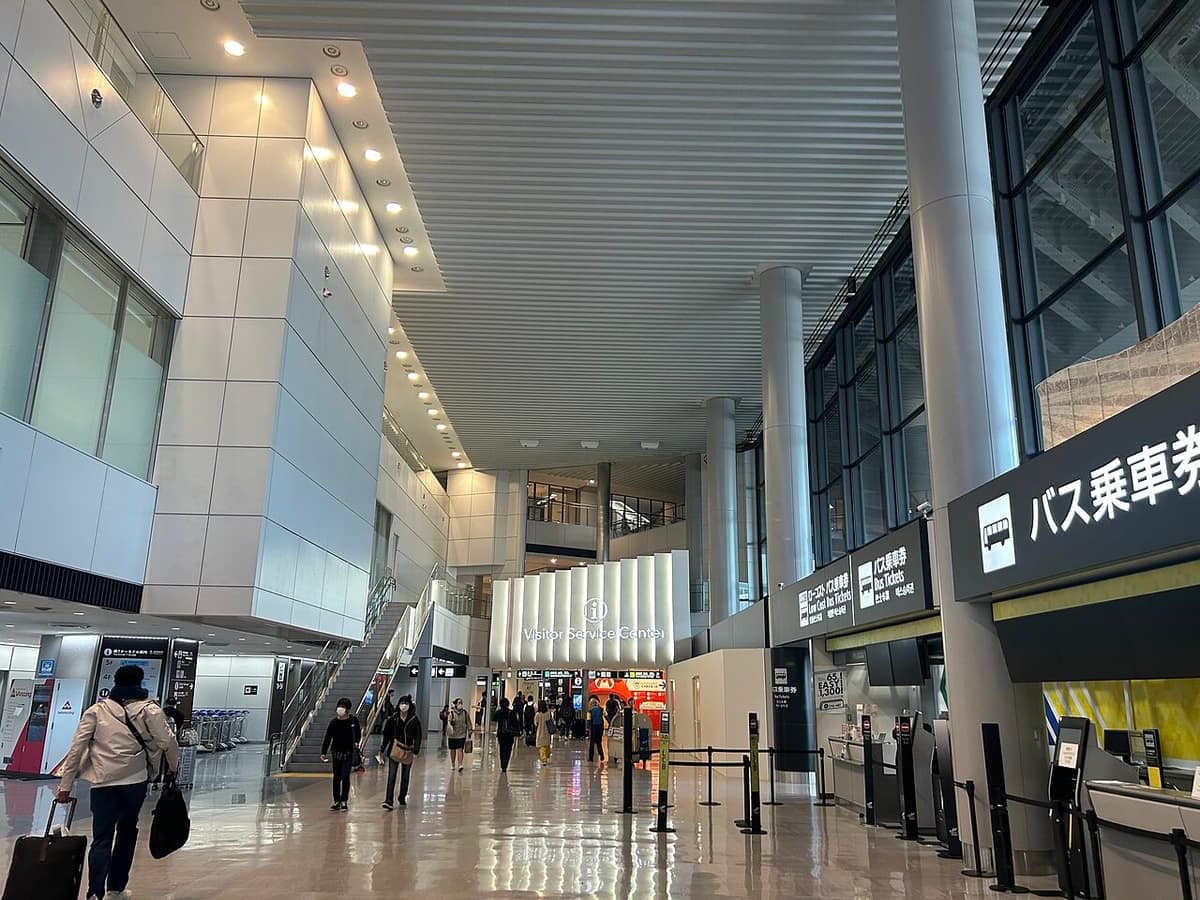
Narita Airport (NRT) lies about 60 kilometres east of central Tokyo in Chiba Prefecture and has three terminals. Terminal 1 and 2 are right at the railway station, while Terminal 3 is a separate building a little further away. Flights operate only from 6:00 to 24:00. This overview shows which airline uses which terminal, how to move between the terminals and which services are available. All details come from the airport operator, as of 25 October 2026.
Key takeaways
- Arrive comfortably: private transfer at a fixed price with Kiwitaxi (advertising), drop your luggage from ¥270 per day with Radical Storage (advertising), eSIM from €3.50 with Yesim* (advertising).
- Three terminals: Terminal 1 and 2 are about a 5-minute walk from the railway station, Terminal 3 about 10 minutes.
- Between the terminals: free shuttle bus before security, about 10 minutes between Terminal 1 and 2.
- Not every low-cost airline uses Terminal 3: according to the airport Peach and ZIPAIR are in Terminal 1, while Jetstar Japan and Spring Japan are in Terminal 3.
- Flight operations only 6:00 to 24:00. If you travel very early or late, you can stay overnight at a hotel at the airport.
- Into the city: Skyliner, Narita Express, Keisei trains, Limousine Bus or taxi, with details in the transport guide.
Which terminals does Narita have and who flies from where?
Narita has three terminals. According to the airport’s airline pages, JAL and Cebu Pacific use Terminal 2, and ANA and United the South Wing of Terminal 1. Peach and ZIPAIR are in the North Wing of Terminal 1, and Jetstar Japan and Spring Japan in Terminal 3. So Terminal 3 is no longer simply “the budget terminal”. The airport does not state which alliance sits in which terminal. What counts is always the terminal on your ticket or in the airline app, because assignments can change.
How do I get between the terminals?
On the landside (before security) a free shuttle bus runs. On its loop the ride takes about 14 minutes from Terminal 1 to Terminal 3, about 3 minutes from Terminal 3 to Terminal 2 and about 10 minutes from Terminal 2 to Terminal 1. Between Terminal 1 and 2 alone it takes about 10 minutes. On foot you reach the information desk in Terminal 3 from the Terminal 2 station through a connecting corridor in about 13 minutes.
If you are transferring after security, you use a separate transfer shuttle. According to the airport it takes about 8 to 12 minutes from Terminal 1 to Terminal 2, about 4 minutes from Terminal 2 to Terminal 3 and about 24 to 28 minutes from Terminal 3 to Terminal 1. The shuttle to Terminal 3 only runs at certain times, and depending on the airline you may not be allowed to use it because of immigration. So allow plenty of buffer when changing.
Which services does the airport offer?
- Luggage: lockers, left luggage and luggage delivery in all three terminals. More in our guide to sending luggage by Takkyubin. Radical Storage* (advertising) brokers luggage storage at partner locations in the city, from ¥270 per day according to the provider.
- Showers: in Terminal 1 (central building, 2nd floor) a shower costs ¥1,500 for 30 minutes, then ¥750 per 15 minutes, open from 7:00 to 20:00.
- Resting: in the secure area there are day rooms for passengers who have checked in: Terminal 1 (central building, 3rd floor, 7:00 to 21:00) and Terminal 2 (satellite, 3rd floor, 7:00 to 21:30), a single room costs ¥3,000 for 60 minutes. There is also a capsule hotel in the P-2 car park at Terminal 2 (around the clock, reservation recommended).
- Food and shopping around the clock: Lawson in Terminal 1 (basement), 7-Eleven and Yoshinoya in Terminal 2 (basement), Lawson and Matsuya in Terminal 3.
- ATMs: open 24 hours are, for example, the Japan Post Bank machines in Terminal 1 (central building, 1st floor) and SevenBank in Terminal 2 (basement). In the secure area the limit is ¥30,000 per withdrawal.
- Observation decks: Terminal 1 (5th floor) and Terminal 2 (4th floor).
- Lounges: only for eligible airline passengers, and the airport page lists no pay-per-use access.
- Wi-Fi: the airport lists Wi-Fi and power outlet areas in all terminals and rental of Wi-Fi routers and SIM cards. We could not confirm free Wi-Fi on the page. All ways to get online are in our guide Internet in Tokyo from the airport. If you want to be online as soon as you land, you can set up an eSIM beforehand, for example from Yesim (advertising) (from €3.50) or Airalo (advertising) (from €4.00).
How do I get into the city?
Skyliner, Narita Express and the Keisei trains serve Terminal 1 and 2 directly, and for Terminal 3 you stop at the station Terminal 2·3. The Skyliner takes 36 to 41 minutes to Nippori and Ueno, and the Narita Express from 53 minutes to Tokyo Station. The Limousine Bus goes to Tokyo Station, Shinjuku, Shibuya and many hotels. Fares, travel times and the last connections are in our guide Narita Airport to Tokyo. You can get a card for trains and buses at the airport, and our IC card guide shows how. If you prefer to book the way in advance, you can find a private transfer at a fixed price with Kiwitaxi* (advertising); the comparison is in the transport guide.
Where can I stay at Narita Airport?
Many travellers stay at the airport before an early departure or after a late landing. Our comparison lists hotels at Narita Airport with direct terminal access or a shuttle of at most 20 minutes. To choose between the two airports, see our guide Haneda vs. Narita.